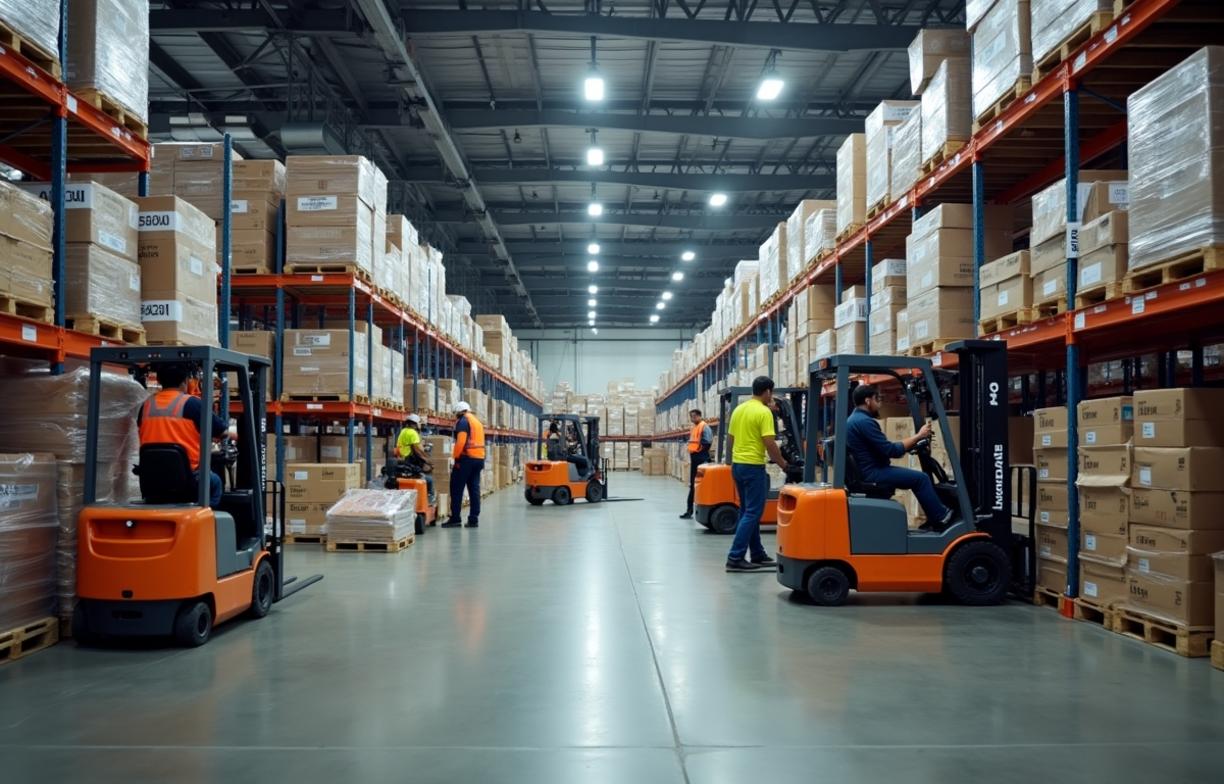
Peak periods can turn a well-run warehouse into a bottleneck within days. Holiday order spikes, back-to-school retail cycles, promotional drops, inventory counts, and port delays all create short labor windows that permanent headcount cannot always cover.
The goal is not just “more people.” The goal is having trained, screened, and scheduled workers in the right zones before overtime, mis-picks, dock congestion, and safety incidents rise. That is where temporary staffing agencies for warehouse operations can help, if the arrangement is planned with clear thresholds and controls.
Know when peak labor is actually needed
A labor gap usually appears first in service metrics, not headcount reports. Watch for dock-to-stock time rising above 24 hours, order cycle time extending beyond the customer promise, or overtime passing 10% of total warehouse labor hours for two straight weeks.
The U.S. Bureau of Labor Statistics tracks warehousing and storage employment under NAICS 493, and its occupational data shows the sector is dominated by transportation and material moving roles, which account for roughly three-quarters of the industry’s 1.9 million jobs. During a peak, the hardest jobs to fill quickly are often forklift operators, case pickers, shipping loaders, kitting staff, and returns processors.
Use a trigger point before managers start hiring reactively. For example, if daily order volume runs 20% above forecast for five business days, or absenteeism exceeds 6% during a known peak, start the staffing request process immediately.
Demand signals that matter
Sales forecasts alone are not enough because warehouse labor follows units, lines, cube, and touches. A 15% increase in orders can create a 30% labor increase if orders contain more split cases, fragile items, or value-added services.
Track received pallets, outbound lines, average units per order, return authorizations, and trailer live-load appointments. These indicators show whether the pressure sits in receiving, replenishment, picking, packing, shipping, or returns.
Internal capacity limits
Your permanent team has a ceiling before quality falls. If pick accuracy drops below 99.5%, or loaders miss carrier cutoffs twice in one week, added labor may be needed even when overtime looks manageable.
OSHA’s warehousing guidance highlights hazards involving powered industrial trucks, manual lifting, conveyor pinch points, and loading docks. Adding workers after fatigue already appears increases exposure during the most compressed part of the season.
Choose the right staffing model
Different peak patterns need different labor setups. A short flash sale does not need the same model as a three-month retail season. The best choice depends on duration, skill level, schedule stability, and supervision capacity.
| Option | Best fit | Conditions to use | Watch closely |
|---|---|---|---|
| Daily flex labor | One- to five-day spikes | Simple unloading, labeling, rework, or clean-up tasks | Attendance, check-in time, and task clarity |
| Seasonal temporary staff | Four- to sixteen-week peaks | Predictable order surges and repeatable warehouse tasks | Training time, productivity ramp, and retention |
| Temp-to-hire | Peaks that may become permanent | Growing accounts or new facility launches | Conversion rules and performance scoring |
| Specialized operators | Equipment or systems-heavy work | Forklift, reach truck, inventory control, or WMS roles | Certification, site evaluation, and error rates |
A daily flex model works when tasks need less than two hours of training. Seasonal staffing works better when workers must learn slotting logic, scanner steps, packing rules, or customer routing guides.
When to use general warehouse temps
General warehouse temps fit receiving support, container unloading, carton sorting, packaging, ticketing, light assembly, and returns triage. These roles should have visual work instructions, clear quality samples, and zone leaders available every shift.
Use this model when productivity can ramp within one to three shifts. If a new worker needs more than 20 hours before contributing safely, a longer assignment usually works better.
When to request skilled workers
Skilled workers make sense when errors cause operational delays or safety risk. Forklift operators, inventory clerks, export packers, and WMS users need screening beyond basic availability.
For powered industrial truck work, OSHA standard 29 CFR 1910.178 requires operator training and evaluation. The host employer should confirm site-specific training, because every warehouse layout, traffic pattern, racking type, and dock setup creates different risks.
Set requirements before the first worker arrives
A vague request creates inconsistent labor. Give the agency job titles, shift times, physical demands, required equipment experience, dress rules, background requirements, and productivity expectations before interviews or dispatch.
Define the essential functions in measurable terms. Examples include lifting cartons up to 50 pounds, standing for 8 to 10 hours, using RF scanners, building pallets to 60 inches, or walking 8 miles per shift in a pick module.
American Staffing Association guidance emphasizes shared responsibility between staffing firms and host employers. The agency handles employment administration, while the warehouse controls day-to-day site instruction, task assignment, and working conditions.
Screening and attendance standards
Ask for screening standards in writing, especially for roles with equipment, inventory access, or customer-specific compliance. Screening may include work history checks, E-Verify participation where used, drug testing, background checks, and skills verification.
Set attendance expectations before the start date. Many warehouses overbook by 5% to 10% during the first week because no-shows can occur when unemployment is low or competing shifts pay similarly.
Training and safety handoff
Do not rely on generic orientation for warehouse-specific risks. Cover pedestrian lanes, dock locks, trailer inspection, emergency exits, pallet stacking rules, battery charging areas, and reporting procedures on day one.
Keep first-day training short but structured. A 30-minute site orientation, followed by supervised task training and a documented sign-off, works better than handing new workers to a busy lead without instructions.
Manage productivity during the ramp
Temporary workers rarely hit full productivity on the first shift. A realistic ramp prevents supervisors from judging too early or ignoring poor fit for too long.
For simple packing or sorting, expect 70% to 80% of standard productivity on day one. For scanner-based picking, expect full pace after three to five shifts if slotting, location labels, and exception handling are clear.
Track output by task, not just by person. A worker assigned to oversized cartons, damaged returns, or replenishment exceptions may look slower than someone packing uniform single-line orders.
Shift structure and supervision
Assign one lead for every 12 to 20 temporary workers, depending on task complexity. Larger groups need check-in control, assignment boards, and staggered breaks to avoid confusion.
Use the same start time for agency workers and internal leads. When supervisors arrive after temps, the first 20 minutes often disappear into badge issues, PPE searches, and unclear assignments.
Quality controls
Peak labor can increase mistakes if inspection waits until shipment. Use in-process checks, especially during the first week of a temporary crew.
Sample the first 10 completed orders per new worker, then move to periodic checks when accuracy stabilizes. For retail compliance work, verify labels, packing slips, carton markings, and routing requirements before the carrier pickup window.
Control legal, safety, and performance risk
Temporary labor creates a shared employment environment. Responsibilities must be split clearly in the service agreement and in daily operations.
The National Institute for Occupational Safety and Health has published guidance on protecting temporary workers, noting that new workers face higher risk when they lack site-specific training. Warehouses should document who trains, who supervises, and who corrects unsafe actions.
Keep timekeeping rules strict. Require sign-in and sign-out records, supervisor approval for overtime, and same-day reporting of missed punches, because payroll disputes become harder to resolve after peak volume passes.
What to include in the agency agreement
The agreement should identify bill rates, overtime rules, replacement timelines, safety responsibilities, workers’ compensation coverage, confidentiality terms, and conversion conditions. It should also state how quickly the agency must respond when attendance falls below the agreed level.
Include a replacement standard for poor fit. A practical threshold is replacing a worker within 24 hours when attendance, safety behavior, or productivity fails documented expectations.
Metrics to review weekly
Review attendance rate, fill rate, turnover, productivity, safety observations, and quality defects every week during peak. A fill rate below 95% for two consecutive scheduled days requires escalation.
Compare agency groups by shift and task, not only by vendor. Night shift may struggle because of transit access, while returns may lag because product condition varies widely.
Build a peak staffing calendar
Start planning six to eight weeks before a predictable surge. That window gives enough time to confirm volumes, approve budget, write job profiles, reserve labor pools, and schedule onboarding.
For major holiday peaks, many warehouse teams start earlier because competing employers recruit from the same labor market. If the site needs more than 50 temporary workers, begin agency selection at least 10 weeks ahead.
Hold a post-peak review within 10 business days after volume returns to normal. Compare forecasted labor to actual hours, identify roles with the highest turnover, and update training materials while supervisors still remember the failure points.