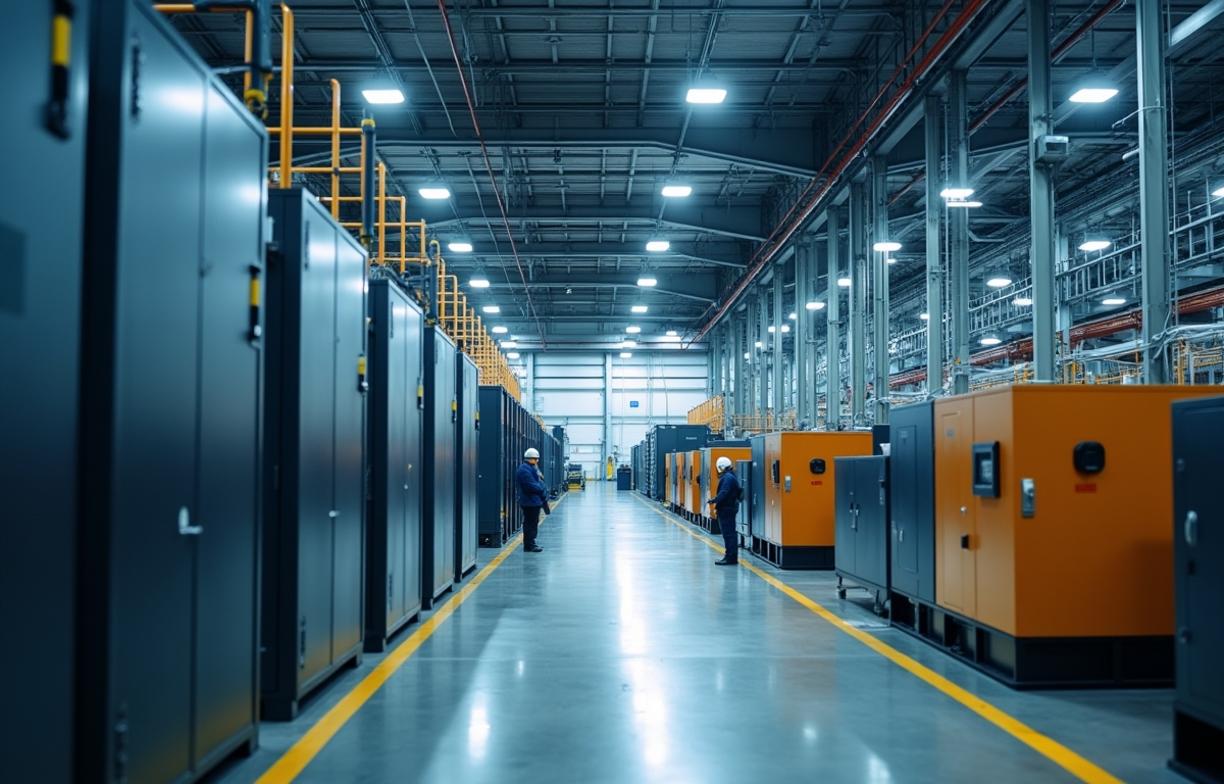
Unplanned power loss can stop a production line in less than a second. Drives fault, PLCs reset, robots lose position, ovens drop temperature, and compressed air headers decay. A five-minute outage can create hours of scrap, cleaning, recalibration, and restart checks.
Manufacturers need more than a generator parked outside. They need a layered power strategy matched to process tolerance, restart time, safety risk, and utility reliability. The right design keeps critical loads alive long enough to ride through brief events or transfer cleanly to standby generation.
Why manufacturing downtime starts with short power events
Many plant interruptions come from voltage sags, momentary outages, and frequency disturbances rather than long blackouts. IEEE 1159 defines momentary interruptions as events lasting from 0.5 cycles to 3 seconds, which is enough to trip sensitive controls. The U.S. Department of Energy has also identified power quality disturbances as a major cause of industrial process disruption.
Manufacturing loads often fail before lights go out. Variable frequency drives can trip when DC bus voltage falls below their undervoltage threshold, often around 65% to 80% of nominal voltage depending on model settings. PLC power supplies may ride through only 10 to 50 milliseconds unless external hold-up is provided.
A packaging line may restart in 10 minutes, while a heat-treatment furnace can require several hours to stabilize after a power loss. Food, pharmaceutical, and chemical processes add cleaning validation, batch disposition, and environmental monitoring time. That restart gap often matters more than the outage duration.
Downtime also compounds across connected systems. One tripped chiller can stop molding machines. One air compressor trip can fault actuators across several lines. One network switch without UPS support can halt data collection and machine coordination.
Map loads by tolerance, not by department
Start with a load inventory that separates critical process loads from convenience loads. Nameplate amperage is useful, but actual running kilowatts, inrush current, harmonic distortion, and restart sequencing matter more. Use power meters for at least seven days, including a planned startup cycle and a peak production shift.
Group loads by how long they can tolerate interruption. Safety PLCs, e-stops, emergency lighting, fire alarm panels, network cores, and control servers often need immediate ride-through. Process loads such as ovens, refrigeration, pumps, and robotics may need seconds to minutes of continuity. HVAC offices and noncritical lighting usually wait.
Practical load tiers
A common tiering model uses three categories. Tier 1 loads cannot drop for more than 20 milliseconds. Tier 2 loads can pause for 10 seconds to 5 minutes if they restart automatically. Tier 3 loads can wait 15 to 60 minutes while standby power stabilizes and operators confirm safe sequencing.
This approach prevents oversizing. A plant rarely needs every load on UPS power. It may only need controls, networks, and key actuators bridged until a generator accepts load.
Compare the main power protection options
Backup power systems work best when each technology covers the outage duration it handles well. UPS units cover cycles to minutes. Generators cover minutes to days. Flywheels and battery energy storage systems cover high-power short duration events, peak support, and transfer bridging.
The National Fire Protection Association’s NFPA 110 classifies emergency and standby power systems by type, class, and level. For example, Type 10 systems must restore power within 10 seconds. That standard is essential when power supports life safety, legally required standby loads, or hazardous process shutdowns.
| Option | Best fit | Typical transfer or response | Common duration | Watchouts |
|---|---|---|---|---|
| Online double-conversion UPS | PLCs, servers, inspection systems, controls | 0 milliseconds | 5 to 30 minutes | Heat, battery maintenance, bypass design |
| Line-interactive UPS | Small panels and network closets | 2 to 8 milliseconds | 5 to 20 minutes | Less protection from severe voltage distortion |
| Diesel generator | Plant feeders, refrigeration, compressors, process loads | 10 to 60 seconds | 24 to 72 hours with fuel planning | Load steps, emissions permits, wet stacking |
| Natural gas generator | Long-duration standby where gas service is reliable | 10 to 60 seconds | As long as gas supply remains stable | Utility gas curtailment and pressure limits |
| Flywheel UPS | High-cycle sag protection and transfer bridging | 0 milliseconds | 15 to 90 seconds | Short runtime and rotating equipment maintenance |
| Battery energy storage system | Fast transfer, demand support, selected production loads | Less than 1 second with proper inverter design | 15 minutes to 4 hours | Fire code review, controls integration, space |
When each option fits
Use an online UPS when controls must never reset and the load is small compared with the whole plant. This includes PLC cabinets, HMIs, industrial PCs, barcode systems, quality vision systems, and network switches. Choose runtime based on generator start time plus safe margin, not guesswork.
Use a generator when production must continue through outages longer than 15 minutes. It fits plants with cold storage, continuous ovens, vacuum systems, wastewater treatment, or high-value work in process. A 500 kW to 2 MW generator usually requires coordinated switchgear, fuel planning, and utility interconnection review.
Use battery storage when the plant faces frequent sags, short outages, or demand peaks. It fits facilities where a generator starts too slowly for sensitive processes. It also helps where emissions limits restrict diesel runtime.
Design details that prevent failed transfers
A generator that starts successfully can still fail the plant if load steps are too large. Large motors, compressors, chillers, welders, and hydraulic power units can pull starting current 5 to 7 times running current. Soft starters and VFDs reduce this shock, but sequencing still matters.
Automatic transfer switches need the correct transition type. Open transition briefly disconnects the load before reconnecting. Closed transition overlaps sources for a short time, often less than 100 milliseconds, but it needs utility approval and protective relaying. Delayed transition can help transformer and motor loads shed residual voltage before re-energizing.
Frequency, harmonics, and grounding
Many modern plants have nonlinear loads from VFDs, rectifiers, induction heating, UPS systems, and LED drivers. IEEE 519 gives recommended harmonic limits at the point of common coupling. High harmonic distortion can overheat transformers, nuisance-trip breakers, and confuse generator voltage regulators.
Grounding also decides whether faults clear correctly. Separately derived systems require bonding and transfer switch choices that match the neutral design. Coordinate this with NFPA 70, the National Electrical Code, especially Articles 250, 700, 701, and 702.
Testing and maintenance schedules that actually reveal problems
Monthly no-load generator runs do not prove production readiness. NFPA 110 calls for routine inspection, operational testing, and load testing for many standby systems. A meaningful plant test includes transfer, load sequencing, alarms, fuel system checks, and operator response.
Battery systems need measured evidence, not visual checks alone. Valve-regulated lead-acid UPS batteries often need replacement after 3 to 5 years in industrial rooms. Lithium-ion systems may last longer, but they still need thermal monitoring, firmware management, and fire detection coordination.
A practical test cadence
Run a short generator exercise monthly and record voltage, frequency, oil pressure, coolant temperature, and start time. Perform a loaded transfer test quarterly for the actual critical bus when process risk allows. Complete an annual full-load or load-bank test for enough time to reach stable engine temperature, often 2 to 4 hours.
Test UPS runtime at least annually against the protected load. Replace weak battery strings before capacity falls below 80% of rated runtime. Verify alarm contacts report to the plant SCADA, building management system, or a staffed monitoring point.
Building the business case with downtime numbers
Use downtime math that operators, finance, and maintenance can verify. Start with lost contribution margin per hour, scrap value, restart labor, missed shipments, and quality hold costs. Keep the model tied to named lines, not a plantwide average.
For example, a line producing 180 units per hour with a $45 contribution margin loses $8,100 per hour before scrap and restart labor. If one outage creates 600 scrapped units, that single event adds $27,000 in margin loss. Those figures make protection priorities clearer than general reliability claims.
The Electric Power Research Institute has reported that power quality events can impose major costs on industrial and digital operations. Local utility interruption records also matter. Request feeder outage history, momentary event data, and planned switching practices before final sizing.
Information to collect before engineering starts
Gather one-line diagrams, 12 months of utility bills, production calendars, motor lists, VFD lists, and existing breaker settings. Add outage logs with timestamps and machine fault codes. Include product hold times, batch values, temperature limits, and maximum safe interruption windows.
Ask operations which loads must restart automatically and which require manual inspection. Ask maintenance which machines fail after sags, not only after blackouts. Ask EHS which systems support ventilation, containment, fire protection, or hazardous shutdown.