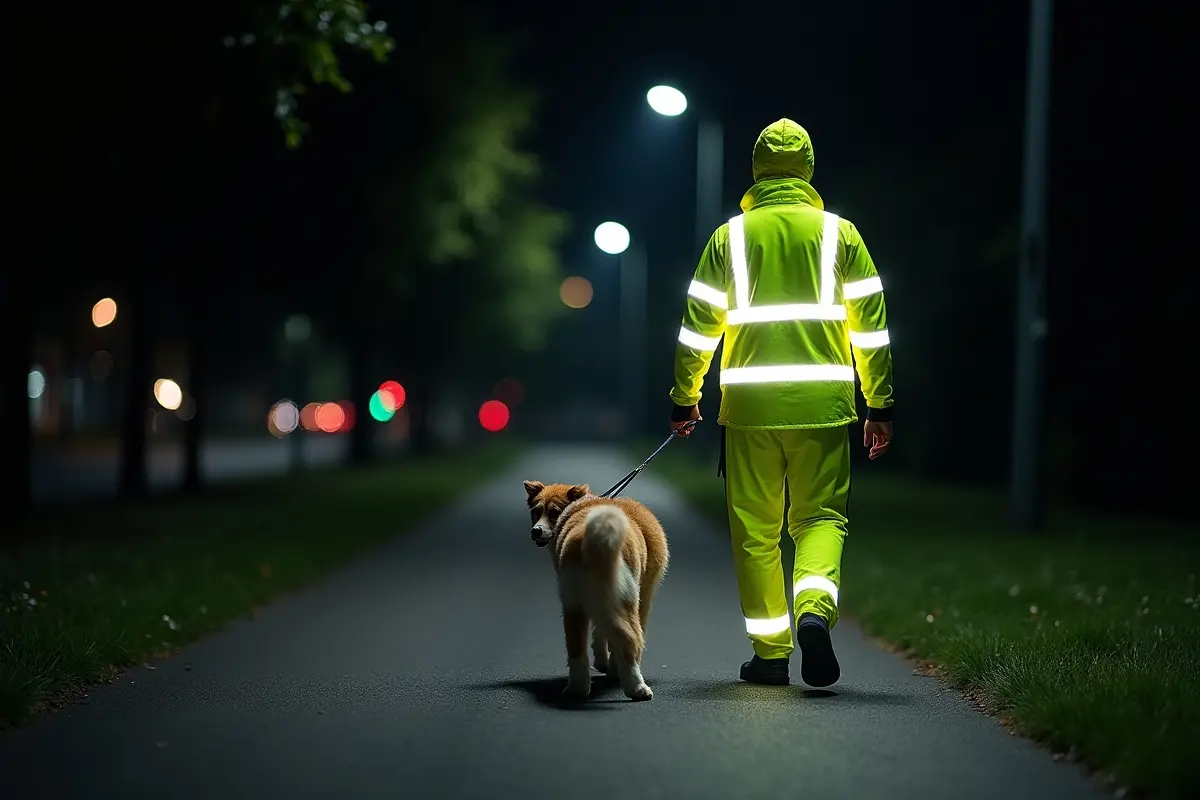
Dog owners often misunderstand the nighttime walk as a minor inconvenience compared to the daytime walk. They think it’s the same path, same equipment, and same routine, just a darker environment. However, these assumptions are incorrect. The darker environment doesn’t just make it harder to see; it also alters the way you and your furry friend perceive the surroundings, potential dangers, and respond to them. To ensure a safe outing, you must appreciate these differences and take specific steps to be ready for them.
Contents
- 1 How Human And Canine Eyes Actually Work In The Dark
- 2 The Visibility Gap: Passive Gear Isn’t Enough On Its Own
- 3 Why Your Phone Is The Wrong Tool For This Job
- 4 Building Your Night-Walk Kit As Travel Equipment
- 5 Leash Choice Matters More At Night
- 6 Shadow Reactivity And Behavioral Preparation
- 7 Route Planning: Walk It In Daylight First
How Human And Canine Eyes Actually Work In The Dark
We are unable to see clearly at night because our eyes are incapable. We see poorly because human eyes evolve to rely on cone cells, which function in bright light conditions and provide the ability to perceive color and detail. However, they don’t perform well when there is not enough light. In such cases, the rod cells take over. Rod cells can detect motion and contrast and work well in low-light conditions but provide much lower image resolution. This is why peripheral vision is often impaired in low-light environments.
Dogs have a structural advantage: the tapetum lucidum. This is a mirror-like structure located behind the retina and reflects light back into the photoreceptor cells, allowing more light to be captured. Hence, dogs have better sensitivity to motion and low light compared to humans. The downside is that the images appear blurry and the shape and details of stationary objects are difficult to perceive.
In summary, your dog won’t be able to navigate the dark walk for you. They will notice moving objects better but they might be confused by shadows, strange shapes, and objects that are not moving. The parked bike might be as invisible to your dog as the squirrel is to you.
The Visibility Gap: Passive Gear Isn’t Enough On Its Own
The piece of advice often given to people who walk their dogs at night – wear something reflective – is not entirely accurate. It’s true that the right reflective gear improves nighttime visibility for you and your dog, but not in all potentially dangerous situations.
Retroreflective gear, the kind of gear that reflects light directly back to its source, is highly effective at alerting someone to your presence when headlights shine in your direction. That’s why so many professional and hobbyist nighttime athletes wear lots of it – it creates an immediate and unmistakable alert when a car, bike, or another person is using a light source that bounces off your gear. But consider all the ways a car doesn’t have its headlights aimed directly at you while you’re on foot: On cross streets. Approaching driveways from an angle. Driving erratically or unsteadily, often associated with texting drivers because their attention isn’t tracking with their headlights. That strip of reflected light bouncing off your jacket only does its job in tiny slivers of all those situations.
Apply two layers of gear – passive, retroreflective gear like the striping on our existing vests, leashes, and collars, that works when lights are aimed at you, and active, light-emitting gear, the kind of gear that actively glows regardless of external light sources. Approximately 76% of all pedestrian fatalities happen in the dark (NHTSA), so that flashing pet collar isn’t even remotely overkill.
Why Your Phone Is The Wrong Tool For This Job
Many people tend to use their phone’s flashlight or screen glow to light up dark areas while walking. Although it may seem like a logical choice, here’s why it’s not the best solution.
First, your phone’s flashlight is not meant to light up a pathway for you. It has a wide, short-range beam that is meant for simple tasks like finding an item in a dark room or reading a menu in a dimly lit restaurant. This type of light doesn’t help you see far ahead, which is necessary when walking in the dark.
Secondly, relying on your phone battery to light your path can be risky, especially in cold weather. Since the battery drains faster in low temperatures, you might end up with a dead phone when you need it most.
Lastly, using your phone light means you’re looking down at the ground, not scanning your surroundings. This makes it hard to see potential dangers like loose tiles, holes, or unwanted animals.
So, instead of using your phone, invest in good quality flashlights built for outdoor use that suit your needs. A compact, weather-resistant handheld light or a hands-free headlamp changes the quality of your awareness on a dark walk – you can scan ahead, check cross-streets, and identify what your dog is moving toward before they get there.
Building Your Night-Walk Kit As Travel Equipment
Here’s a mental reframe that actually changes how prepared people get: treat the nighttime dog walk like a short outdoor excursion, not a trip to the mailbox. The gear requirements aren’t identical to a hiking trip, but the organizational discipline is.
The right way to approach this is to assemble a compact kit and keep it ready. A small utility belt or lightweight pack works better than jacket pockets because the contents stay consistent – you don’t leave the waste bags in yesterday’s coat. That kit should include:
A dedicated backup light source, kept separately from your primary one. If your headlamp dies or gets dropped, you’re not navigating by phone. A compact backup LED light weighs almost nothing.
A basic first-aid kit sized for minor injuries – paw cuts, scrapes from a stumble, your own scraped palm from catching a fall. Night walks on unfamiliar-feeling terrain increase the odds of small accidents.
An emergency whistle. This is for confrontations with aggressive dogs or unexpected wildlife, not emergencies that call for a phone. It works when your hands are occupied and your voice might not carry.
Physical ID on your dog’s collar. Microchips are excellent, but they require a scanner. A readable tag with your phone number works immediately if your dog bolts into the dark and someone finds them.
The “two is one, one is none” rule applies here: any single piece of critical equipment can fail. If your light is the only one, you’re one dropped flashlight from a significantly more dangerous walk.
Leash Choice Matters More At Night
Retractable leashes pose a safety hazard in low-light situations, which we’ll address head-on here. The thin nylon cord rolls out from the handle, effectively disappearing in the dark. A passing bicyclist, a jogger on your left, or another dog and walker won’t notice a cord running out 15 feet into the night until they’ve run into it.
Aside from the danger retractable leashes pose to others, they put you at a mechanical disadvantage. If your dog bolts after a car, a wild animal, or an unseen threat, you’re making split-second decisions with a thin cord under variable tension instead of making a quick, controlled redirection with a point of contact directly on your hand. That’s not an ideal situation to find yourself in when seconds count and your reaction time is further impaired by the darkness.
A proper fixed-length leash – 4 to 6 feet – keeps your dog within the circle of the leash handle light, guarantees that other people can see the handle in your hand, and maintains short-term mechanical control if you need to make a fast correction.
Shadow Reactivity And Behavioral Preparation
Dogs who are relaxed and easygoing during day strolls can develop reactivity after dark – and that’s not a training or socialization flaw on your part. This is an ancient survival issue. Animals that you might prey on or that might prey on you are generally active during low light, as are some of the threats like ambush predators. So shadows and slight movements are, neurologically and primordially, things with danger potential. Leaves on the move, a headlight’s edge uneasily close to your fence, something not immediately recognizable – dogs are hardwired to see these things as potential threats, because they might be.
Counter-conditioning your dog to be less reactive to shadow byproducts means controlled exposure to those stimuli in non-stressful situations: nothing unpredictable on your walk except the leaf-blowers, well-lit paths you and your dog already know, your presence, treats handy. You re-teach your dog to respond to seemingly threatening shadows by providing gentle, non-rough interaction and rewarding correct behavior. The goal is to build enough positive association with ambiguous nighttime stimuli that your dog’s default response becomes “look at handler” rather than “lunge and bark.”
The “leave it” command is especially worth maintaining at a high level of reliability for night walks. Your dog can detect things on the ground – animal droppings, discarded food, dead wildlife – that you won’t see until they’re already investigating. A solid “leave it” response prevents contact with potential toxins you can’t even see.
Canine cognitive dysfunction in senior dogs can make nighttime anxiety worse, with some dogs showing increased disorientation and pacing after dark. If you have an older dog that seems significantly more anxious on night walks than daytime ones, that’s worth a conversation with your vet rather than a training solution.
Route Planning: Walk It In Daylight First
Walk the route in daylight before making a commitment to any after-dark routine. Identify the minutiae and specific stressors hidden by darkness. Raised or broken sidewalk slabs. Blind driveways – where cars exit locations without a sightline of sidewalk traffic. Chain-link fences with reactive dogs. Stray areas of construction. Squirrel feeders. Low-hanging branches at face height.
Map the locations where streetlights fail. Most walk routes have a few of these. Some are entire blocks long. None of these are as big a problem in daylight as they become at night.
When you walk the route at night, face traffic. Keep your dog on your inside shoulder, between you and the buildings or edge – not between you and the road. At intersections, don’t assume a driver sees you. Use your light beam to make eye contact confirmation before stepping off the curb.
Tell someone the route and your estimated return time. Real-time location sharing apps exist now. It takes them 30 seconds to set up. If you aren’t back when you say you will be, they have a place to start looking.
Night walks aren’t inherently dangerous, but they’re not automatically safe just because the neighborhood is familiar. The difference between a routine outing and a serious incident is usually a single unaccounted-for variable – a driver distracted at an intersection, a startled dog bolting into a road, a fall on a curb nobody saw. The preparation outlined here isn’t excessive for a short neighborhood loop. It’s proportional to the actual risk.